

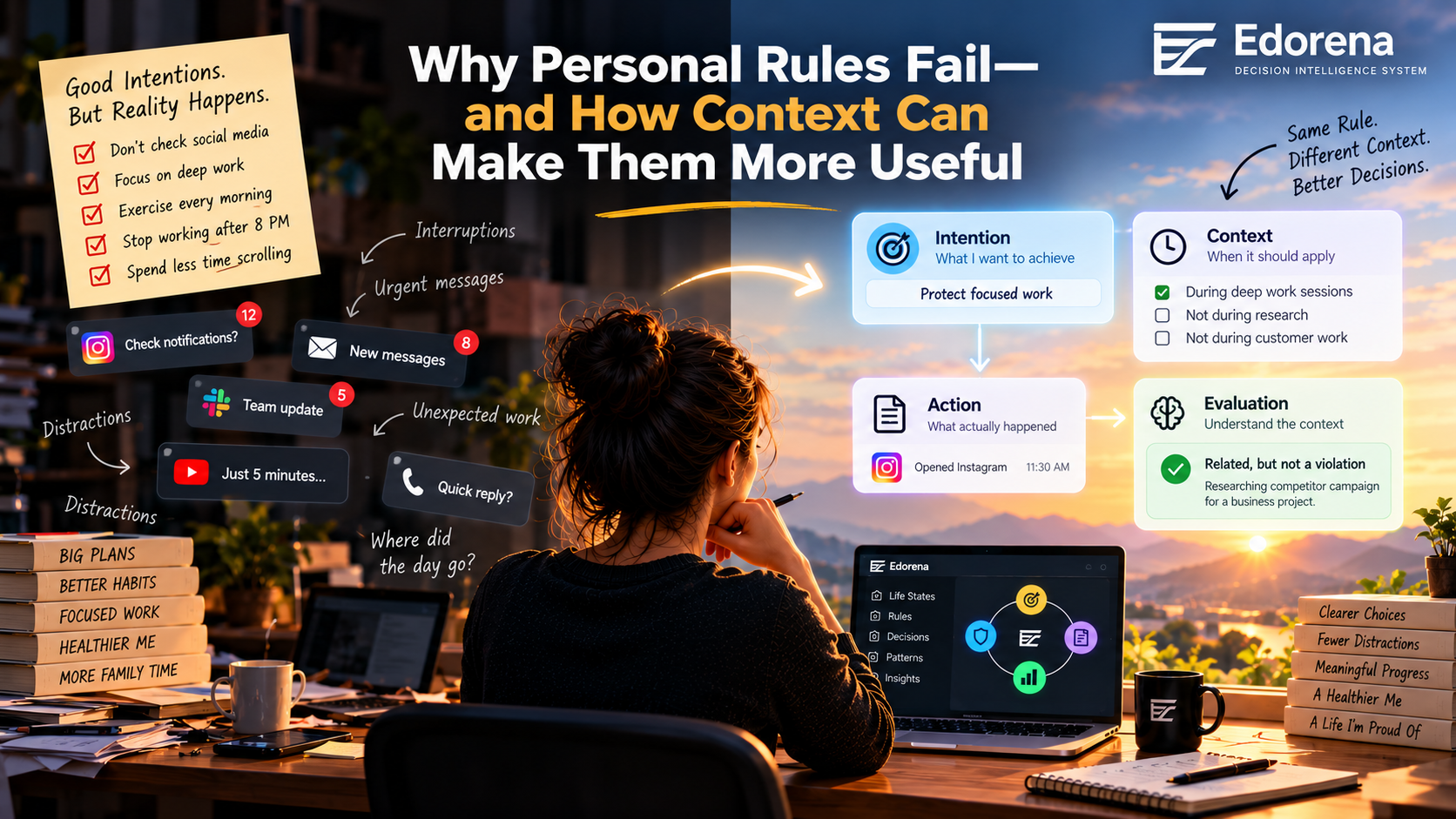
Most of us have made rules for ourselves.
Don’t check your phone while working.
Exercise before the day gets busy.
Stop working at a reasonable hour.
Spend less time scrolling.
We create these rules because we want to change something about our lives. And often, we genuinely believe they will help.
But a few days later, reality gets complicated.
A message needs an urgent reply. A project runs late. We feel tired. An unexpected responsibility appears.
Suddenly, the rule that seemed so simple becomes difficult to follow.
This raises an interesting question:
Are we bad at following rules, or are we creating rules that don’t account for the situations in which we actually live?
A rule can be right—and still be wrong for the moment
Imagine someone creates this personal rule:
Avoid social media during focused work.
The intention is clear. They want to protect their attention and make progress on meaningful work.
But now consider three situations.
They’re scrolling through unrelated videos during a writing session.
They’re researching a competitor’s campaign for a business project.
They’re responding to a customer who contacted them through social media.
The same application is involved in all three situations. Yet the activities have different purposes.
A system that simply detects social media usage might treat every instance as a violation.
That could produce frustrating results. The person might begin ignoring the system because its feedback doesn’t reflect reality.
The problem isn’t necessarily the rule itself.
It’s how the rule is interpreted.
Context changes what a rule means
Personal rules are rarely universal.
“Don’t interrupt focused work” means something different during a planned writing session than during a collaborative meeting.
“Stop working after 8 PM” might be a useful boundary on an ordinary evening, but an exceptional deadline may require a deliberate adjustment.
“Exercise every morning” might support a healthy routine, but illness, travel, or an unusual schedule can change what is reasonable.
Rules become more useful when we consider three things:
1. Intention: What is this rule meant to protect or achieve?
2. Context: When and under what circumstances should it apply?
3. Evidence: What actually happened, and do we know enough to interpret it?
This doesn’t mean every rule needs a complicated configuration.
It means the system evaluating a rule should avoid assuming that a superficial match automatically proves a meaningful conflict.
What this means for productivity software
Most productivity tools are designed to help us plan, organize, and complete activities.
But there is another opportunity: helping people understand whether their everyday actions are consistent with the intentions they’ve chosen.
That requires software to do more than store a rule.
It needs to connect the rule with relevant actions, understand when the rule applies, and communicate uncertainty instead of presenting every possible conflict as a fact.
For example, a system might distinguish between:
- An action that clearly conflicts with a personal rule.
- An action that appears related but needs more context.
- An action that is consistent with the user’s intention.
- An event that cannot be interpreted reliably from the available information.
That distinction could make personal feedback more useful and less intrusive.
It could also help people refine their rules over time.
Perhaps a rule is too broad. Perhaps the situation in which it applies needs to be clearer. Perhaps the person’s priorities have changed.
The point isn’t to create a system that constantly tells people what they did wrong.
It’s to create one that helps them understand their own choices.
This is a problem we’re exploring with Edorena
While building Edorena, I’ve been thinking about how a decision-intelligence system can connect personal intentions, work states, rules, and everyday actions.
One important engineering challenge is determining when an action is genuinely relevant to a rule.
Exact text matching is rarely enough. Related words or applications don’t necessarily imply the same purpose, and context can change the interpretation.
We’re working on making rule evaluation more meaningful by considering these relationships rather than treating every superficial match as a violation.
It’s still an evolving product, and there are plenty of edge cases to solve.
But the broader idea is simple:
Technology should help people create rules that support their lives—not make their lives revolve around following software rules.
A question worth discussing
Think about a personal rule you’ve tried to follow.
Did it become difficult because you lacked discipline, or because the rule didn’t account for the circumstances you were in?
And if a productivity tool could understand the context behind your actions, would that make its feedback more useful—or would you prefer to keep the interpretation entirely in your own hands?
I’d love to hear how others think about this.
#Edorena #DecisionMaking #Productivity #RuleEngine #BehaviorChange #AI #BuildInPublic #FutureOfWork
