

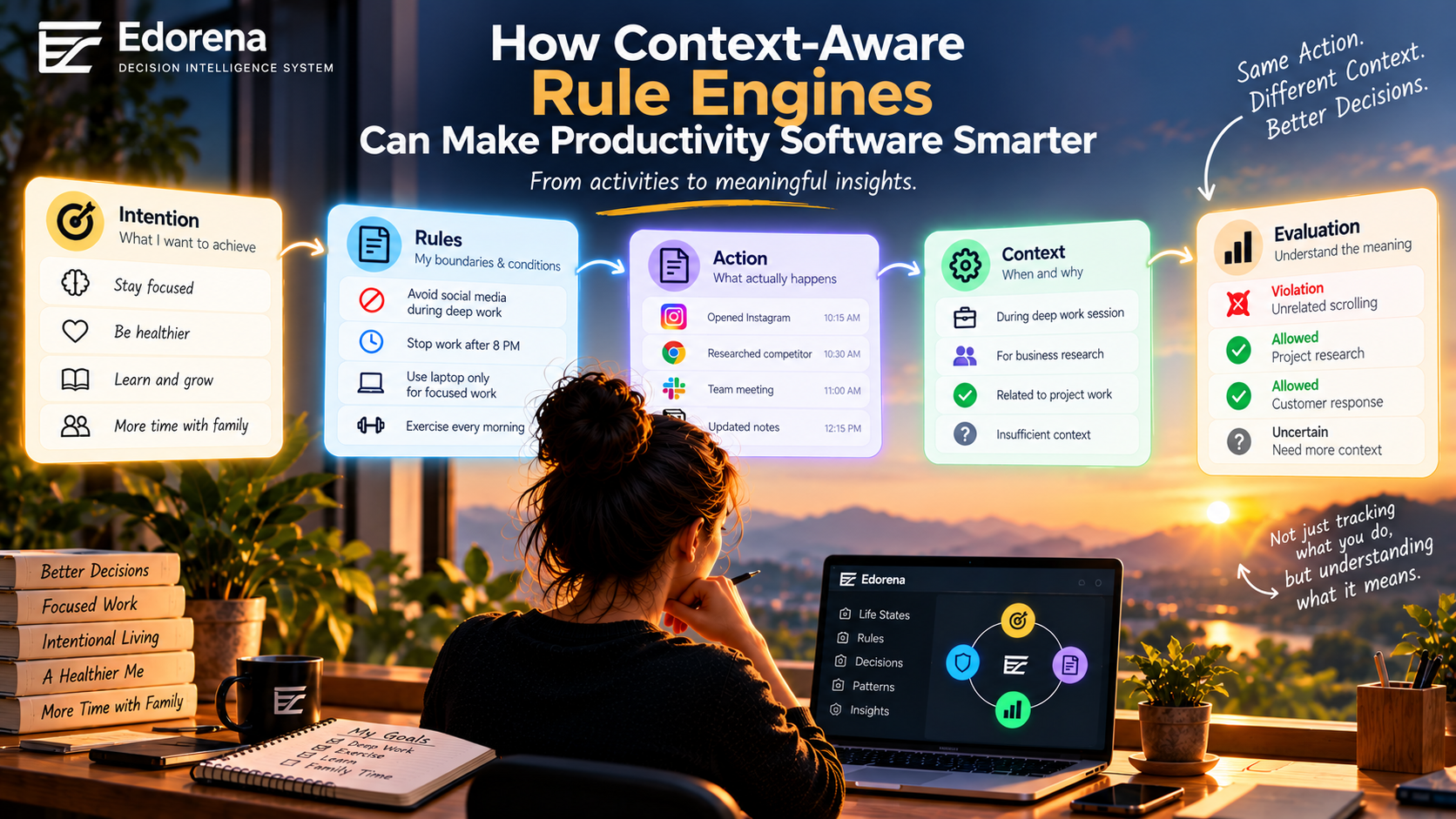
Productivity software has become excellent at tracking activity.
We can see how many tasks we completed, how much time we spent on a project, and how often we followed a routine. Modern applications can also automate reminders, organize workflows, and use AI to interpret information.
But tracking an activity and understanding its meaning are two different challenges.
Consider someone who wants to protect their attention during focused work. They create a rule to avoid unnecessary social media use.
Later, they open a social media application.
Did they break their rule?
The answer depends on what they were doing, why they were doing it, and whether the rule actually applied to that situation.
This simple example illustrates an important challenge in productivity software: how can a system evaluate an action against a personal rule without ignoring the context that gives the action meaning?
What Is a Rule Engine?
A rule engine is a software component that evaluates conditions and determines what should happen when those conditions are met.
A simple rule might look like this:
IF a condition is satisfied, THEN perform an action.
Rule engines are used in many areas of software, including business automation, access control, workflow management, and data validation.
For example, an application might apply a discount when an order exceeds a certain amount, or prevent a user from accessing a resource without the required permission.
These cases often have clearly defined conditions.
Personal productivity is more complicated because the rules may describe intentions, habits, or preferred ways of working.
A rule such as “avoid distractions during deep work” does not always have a single, objectively correct interpretation.
To evaluate it meaningfully, the system needs to consider more than whether a particular word or application appeared in an activity record.
Why Exact Matching Is Not Enough
Imagine a person creates this rule:
Avoid social media during focused work.
Now consider four activities:
- Browsing unrelated videos during a writing session.
- Researching a competitor’s social media campaign.
- Responding to a customer through a social platform.
- Opening a social media application accidentally.
All four activities might involve the same application.
However, they do not necessarily have the same relationship to the person’s intention.
A basic keyword-based system could treat each activity as a potential violation. That would be easy to implement, but the results could be misleading.
This is where context-aware rule evaluation becomes useful.
Rather than treating a shared keyword as sufficient evidence, the system can examine the relationship between the action and the rule.
Five Questions a Context-Aware Rule Engine Should Consider
1. Does the action directly match the rule?
An exact match can provide strong evidence when the rule is specific.
For example, a rule prohibiting a particular activity may be straightforward to evaluate if the activity is recorded clearly.
However, exact matches alone cannot capture every meaningful relationship.
2. Is the action related to the rule?
Different descriptions can refer to similar behavior.
A system may need to recognize that “checking a social notification” and “opening a social media feed” are related to a rule about social media distractions.
But a related action is not automatically a violation. Relevance is only one part of the evaluation.
3. Does the object or category matter?
Rules may refer to applications, websites, types of activities, or categories of behavior.
Recognizing the object involved can help identify potentially relevant actions.
The system should still avoid assuming that every use of an object has the same purpose.
4. What was the surrounding context?
A person’s active work state, stated intention, and applicable conditions can change how an action should be interpreted.
For example, opening a messaging application during a planned writing session may have a different significance than opening it during a customer-support session.
Context helps establish whether a rule applies in the first place.
5. Is there enough evidence to reach a conclusion?
Sometimes the system will not have enough information to determine whether an action conflicts with a rule.
In these situations, uncertainty should be handled explicitly.
An ambiguous action should not automatically become a confirmed violation.
This distinction can help reduce false positives and preserve user trust.
From Activity Tracking to Meaningful Feedback
A productivity application can record that someone opened a website, switched applications, or postponed a task.
But the more useful question may be whether that activity relates to something the person intended to protect.
Imagine a person repeatedly postpones a learning goal whenever urgent messages arrive.
An activity tracker might report that the learning sessions were missed.
A system connecting intentions, rules, and actions could potentially help the person investigate a recurring pattern:
- What was the original intention?
- Which circumstances repeatedly interrupted it?
- Was there a personal rule intended to protect the activity?
- Does the rule need clarification or adjustment?
The system should not automatically assume that postponing a goal is wrong. There may be valid reasons to change priorities.
Instead, the value lies in making relevant information easier to review.
That can support reflection without replacing the person’s own judgment.
How Edorena Is Exploring This Problem
Edorena is a decision-intelligence system being developed around the relationship between personal intentions, work states, rules, and everyday actions.
One part of that work is improving the rule engine so it can evaluate text and actions more meaningfully.
The challenge is not simply identifying similar words. It is determining whether a relationship is relevant to a particular rule and whether the available context supports a useful interpretation.
For example, a rule about avoiding distractions during focused work should be evaluated differently from a rule about completing a particular project activity.
The engine needs to consider the rule’s purpose and scope, not just the presence of related text.
This is an evolving engineering problem. Better matching can help identify relevant relationships, but contextual evaluation, uncertainty, and false positives remain important considerations.
The goal is to make feedback more useful—not to label every action as correct or incorrect.
What This Could Mean for the Future of Productivity Software
Traditional productivity tools help people organize tasks and manage schedules.
Context-aware systems could add another layer by helping people understand how recorded actions relate to their intentions.
That does not mean every productivity application needs a complex rule engine.
Different users need different levels of structure, and some workflows are best served by simple task lists or reminders.
But for systems that aim to provide personalized behavioral feedback, context matters.
A rule is useful only when it can be interpreted in a way that reflects the situation in which it was created.
As software becomes more capable of analyzing natural language and activity data, the quality of that interpretation becomes increasingly important.
The opportunity is not to build software that constantly judges what people do.
It is to build software that helps people recognize relevant patterns, review their own choices, and decide whether they want to change anything.
Better productivity feedback begins when software stops treating every action as an isolated event and starts considering what that action means in context.
