

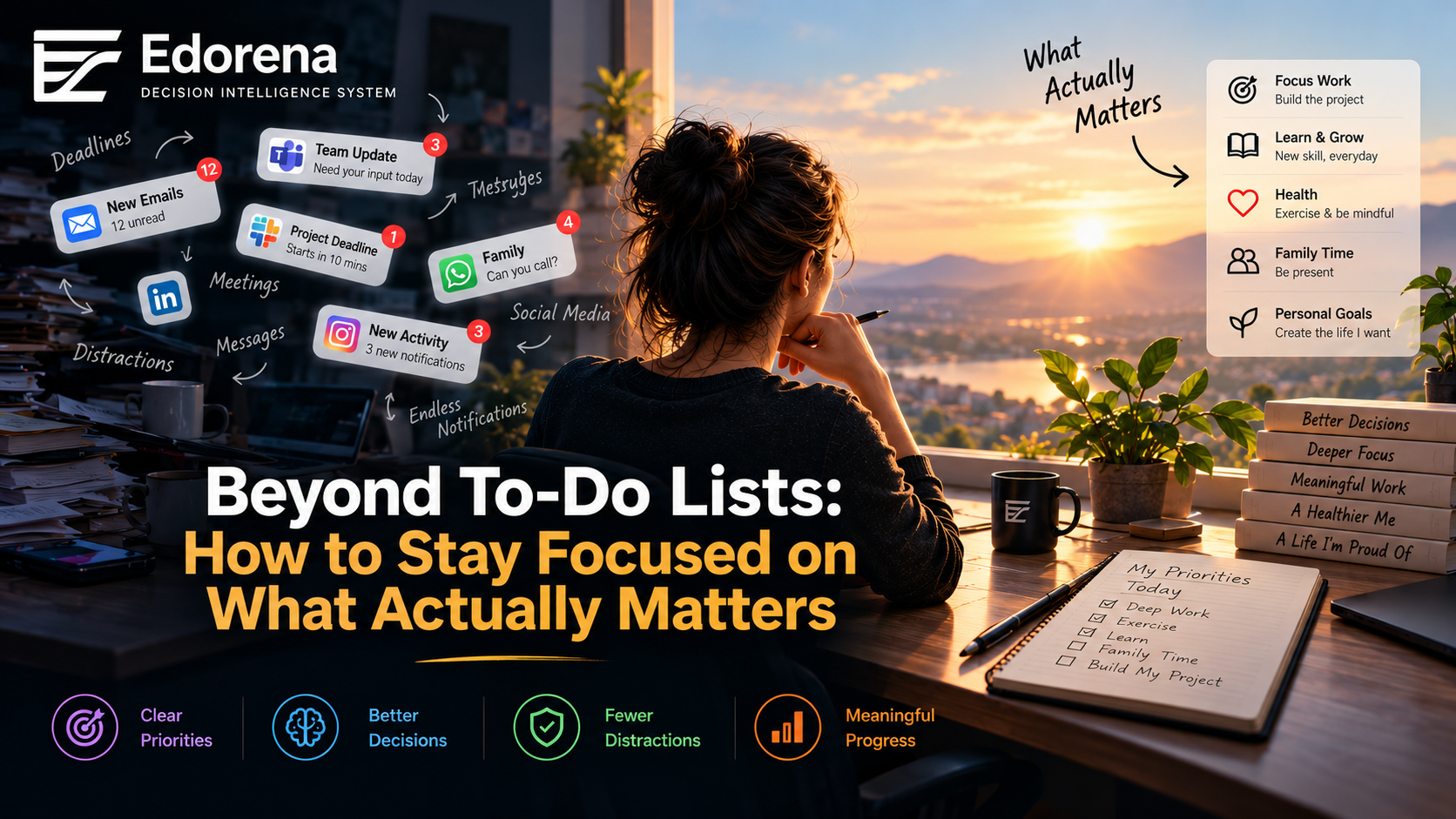
Beyond To-Do Lists: How to Stay Focused on What Actually Matters
In a world filled with notifications, deadlines, meetings, and endless information, staying productive has become increasingly difficult.
There is no shortage of productivity apps promising to help us organize our schedules, manage tasks, and accomplish more in less time. From digital planners to AI-powered assistants, technology has made it easier than ever to plan our days.
Yet many people still finish the day wondering where their time went.
The problem is not always a lack of organization. Sometimes, it is the gap between what we intend to accomplish and what we actually spend our time doing.
To improve productivity, we need to look beyond task lists and understand how we prioritize, make decisions, and respond to everyday distractions.
1. Why Traditional Productivity Apps Are Not Always Enough
Task management apps are useful for organizing responsibilities, setting deadlines, and tracking progress. They provide structure and make complicated workloads easier to manage.
However, knowing what needs to be done does not automatically mean we will do it.
Imagine starting your morning with three important priorities. You open your laptop, check your email, respond to a few messages, attend an unexpected meeting, and handle several small requests.
By the afternoon, you have completed plenty of activities, but your most important work remains untouched.
Your task list may be perfectly organized. Your priorities may still be clear. Yet your actions have gradually moved in another direction.
This is an important limitation of productivity systems that focus exclusively on tasks: they help us record what needs to happen, but they may not help us recognize when our daily choices are moving us away from our intentions.
2. The Hidden Productivity Problem: Losing Sight of Priorities
One of the biggest challenges in personal productivity is maintaining focus on meaningful goals while handling immediate responsibilities.
Urgent tasks naturally attract attention. Messages require replies, deadlines approach, and unexpected problems demand solutions.
Long-term priorities, on the other hand, often have no immediate consequences when postponed.
Learning a new skill, developing a business, exercising regularly, or working on a creative project can easily become tomorrow’s responsibility.
When this happens repeatedly, small decisions begin to shape larger patterns.
You might intend to spend an hour learning something new but use that time scrolling through content. You might plan to work on an important project but spend the morning responding to requests. You might promise yourself an earlier bedtime but continue working without a clear stopping point.
Individually, these decisions may seem insignificant. Over time, however, repeated choices can influence habits, progress, and personal goals.
Improving productivity therefore requires more than managing time. It also requires understanding how everyday decisions affect our priorities.
3. How to Improve Productivity Without Adding More Tools
Installing another application is not always the answer. Sometimes, a few simple changes to how you approach your day can make a meaningful difference.
Start with one meaningful priority
Instead of beginning with a long list of tasks, identify the one outcome that would make the day feel worthwhile.
This does not mean ignoring other responsibilities. It means giving your most important work a clear place in your schedule.
Match your work to your current situation
Different activities require different kinds of attention.
Planning a strategy, writing a report, responding to emails, and solving a difficult problem do not demand the same level of concentration.
Before choosing your next activity, consider the time available, your current energy, and the type of thinking required.
When circumstances change, adjusting your plan can be more useful than trying to follow it rigidly.
Establish simple personal rules
Rules can reduce the number of decisions you need to make throughout the day.
For example:
- Complete one focused work session before checking non-urgent messages.
- Keep your phone away during important work.
- Review your priorities before starting a new project.
- Set a stopping time to protect personal and family time.
The purpose is not to create a perfect routine. It is to make important actions easier to repeat.
Review what actually happened
At the end of the day, take a few minutes to reflect.
What moved forward? What distracted you? Which decisions helped you? What would you change tomorrow?
This short review can help you recognize recurring patterns rather than treating every unproductive day as an isolated failure.
4. Choosing a Productivity App That Fits Your Needs
The best productivity app depends on the problem you are trying to solve.
Some people need a straightforward task manager. Others need calendar planning, team collaboration, habit tracking, or tools for protecting focused work.
When comparing productivity software, consider these questions:
- Does it help you identify your most important priorities?
- Can you organize work without creating unnecessary complexity?
- Does it support consistent habits and personal rules?
- Can you review your progress and learn from recurring patterns?
- Does it complement your existing workflow?
It is also worth considering whether you need another tool for managing tasks or a different approach to understanding your decisions.
For people interested in the connection between intentions and everyday actions, Edorena explores a decision-intelligence approach to productivity.
Rather than treating productivity as a list of activities to complete, Edorena focuses on intentional work states, personal rules, decision awareness, and behavioral patterns over time.
The goal is to help people better understand how their daily choices relate to what matters to them.
This approach can complement traditional productivity tools rather than requiring people to abandon the systems they already use.
5. The Future of Productivity Is About More Than Doing More
For years, productivity has largely been measured by output: how many tasks we complete, how quickly we respond, or how efficiently we use our time.
These measurements are useful, but they do not tell the entire story.
A person can complete dozens of tasks and still neglect their most important goal. Another person can complete fewer tasks while making meaningful progress on something that matters deeply.
The difference is not always effort. It can also be the quality of prioritization and the decisions made throughout the day.
As AI and productivity software continue to evolve, there is an opportunity to build systems that help people do more than organize information. They can also help people reflect on their choices, recognize patterns, and stay connected to their intentions.
Technology should not simply encourage us to fill every available hour.
It should help us make better use of the time, attention, and energy we have.
Final Thoughts
Improving productivity does not always mean finding a better planner, adding more reminders, or creating a more complicated routine.
Sometimes, it begins with a simpler question:
Are my daily actions helping me move toward what actually matters?
Use productivity apps to create structure. Establish personal rules to protect your priorities. Make time to reflect on your decisions and adjust when your circumstances change.
The objective is not to make every day perfect.
It is to become more intentional about how you spend your days and where your repeated choices are taking you.
Because productivity is not just about getting things done. It is also about making sure the things you do contribute to the life you want to build.
