

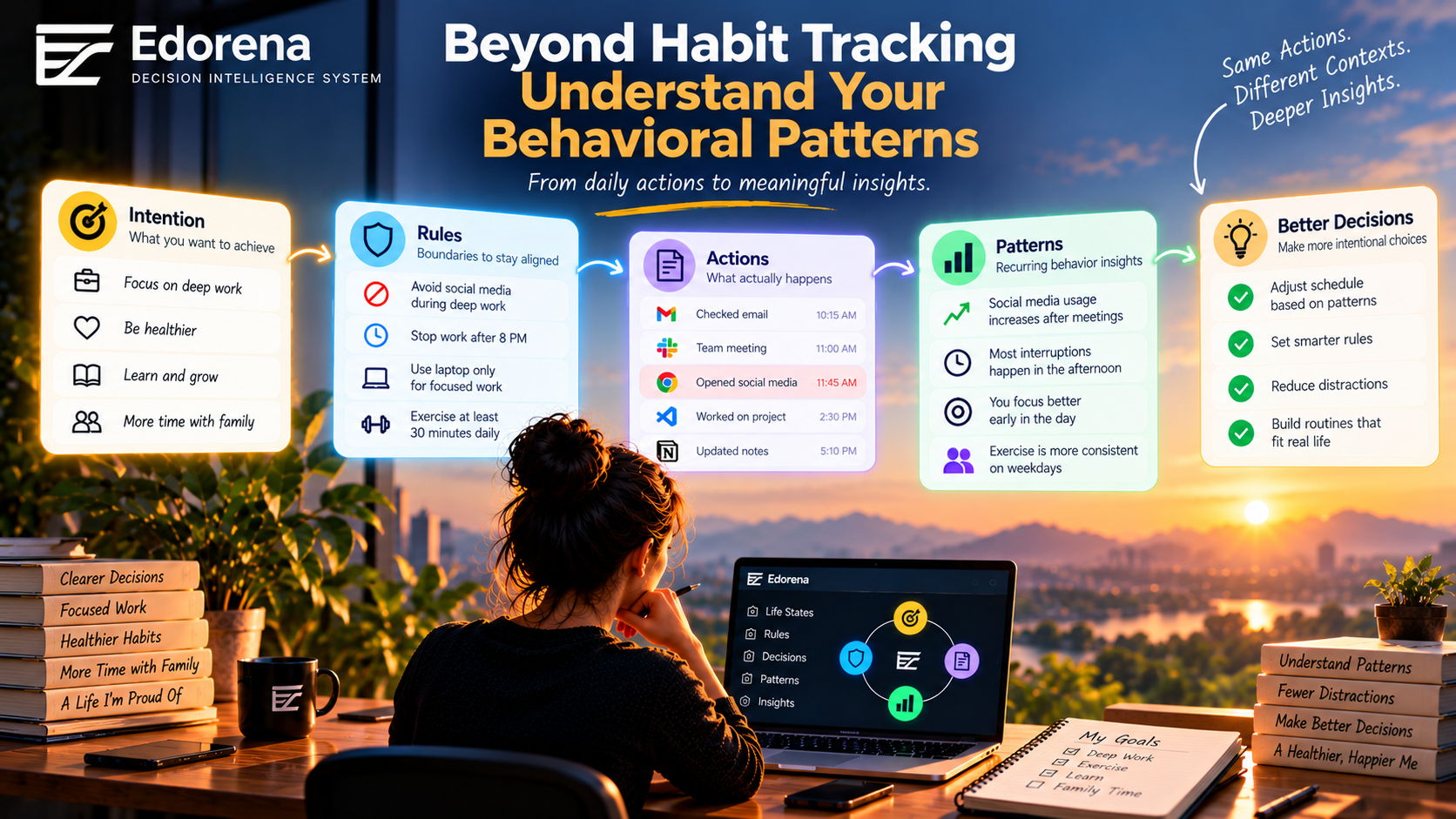
Beyond Habit Tracking: Why Understanding Your Behavioral Patterns Matters
Most people have tried to build a better habit at some point.
Wake up earlier. Exercise regularly. Spend less time on social media. Learn a new skill. Protect time for important work.
We set goals, create reminders, and sometimes install an app to track our progress.
Initially, everything feels straightforward. We know what we want to change, and we have a way to measure whether we are doing it.
Then real life gets in the way.
We skip a workout, postpone an important task, spend longer on our phones than intended, or abandon a routine after a particularly busy week.
One missed day does not tell us much. But when the same situations repeatedly lead to the same outcomes, something more interesting may be happening.
The real opportunity is not simply tracking what we do. It is understanding the patterns behind what we repeatedly do.
1. What Habit Tracking Can and Cannot Tell You
Habit tracking is a useful way to build consistency.
A tracker can show whether you exercised today, completed a reading session, or followed a morning routine. Over time, these records help you see whether a behavior is becoming more consistent.
However, tracking completion does not always explain why a habit succeeds or fails.
Imagine someone who plans to study for 30 minutes every evening but repeatedly misses the session.
A habit tracker might show several incomplete days.
But the reasons could be very different:
- Work regularly runs later than expected.
- The person feels mentally exhausted in the evening.
- Family responsibilities take priority.
- The study session has no clearly defined starting point.
- The goal is too ambitious for the available time.
Each explanation suggests a different solution.
Adding more reminders might help with forgetfulness, but it will not necessarily solve a scheduling problem or an unrealistic expectation.
Tracking tells us what happened. Understanding the surrounding circumstances helps us investigate why it might have happened.
2. Behavioral Patterns Often Appear Across Different Situations
A behavioral pattern is a recurring relationship between circumstances and actions.
For example, someone might repeatedly postpone difficult tasks when several small requests arrive at once.
Another person might find it easier to exercise when the activity is scheduled in advance rather than left to an open-ended decision.
Someone else might consistently abandon personal projects when work becomes unusually busy.
These examples do not automatically prove a cause. People have complex lives, and the same behavior can have different explanations.
However, repeated observations can reveal useful questions.
What tends to happen before a planned activity gets postponed? Which circumstances make a routine easier to maintain? Are certain priorities repeatedly displaced by the same kinds of interruptions?
Instead of treating every missed goal as an isolated failure, we can look for recurring relationships worth investigating.
That shift can make self-improvement more practical and less focused on blame.
3. Why Context Matters When Trying to Change Behavior
The same action can have different meanings depending on the situation.
Spending an hour on social media might be unplanned distraction during focused work. It might also be part of a professional research task or a deliberate way to relax after work.
Similarly, postponing a task might reflect avoidance, or it might be the sensible response to a more urgent responsibility.
A useful system should not assume that every deviation from a plan is a mistake.
Context helps us interpret what happened.
When reviewing a behavior, consider three questions:
What was I trying to achieve?
Start with the intention behind the activity. A clear intention makes it easier to evaluate whether the outcome was useful.
What was happening at the time?
Consider the schedule, environment, competing responsibilities, and other circumstances that may have influenced the decision.
Is this a recurring pattern or an isolated event?
One unusual day should not automatically become a conclusion about your behavior. Look for repeated observations before deciding whether a change is necessary.
These questions encourage a more balanced approach to behavior change: observe first, interpret carefully, and adjust deliberately.
4. From Goals to Personal Rules
Goals describe what we want to achieve. Personal rules can help translate those goals into everyday choices.
For example, someone who wants to improve their concentration might establish a rule to keep their phone away during focused work.
Someone who wants to learn consistently might reserve a specific time for studying before opening entertainment apps.
A person trying to protect family time might establish a boundary around when work notifications are checked.
These rules reduce the need to reconsider the same intention throughout the day.
However, personal rules should remain practical. A rule that ignores changing circumstances can become a source of frustration rather than support.
The aim is to create useful boundaries that reflect personal priorities while leaving room for legitimate exceptions.
Reviewing rules periodically can help you determine whether they still serve their original purpose.
5. How Technology Can Help Us Understand Behavioral Patterns
Traditional productivity apps focus on activities such as tasks, schedules, habits, and reminders.
These tools are useful, but there is an opportunity to connect more of the information they represent.
Imagine a system that allows someone to define an intention, associate personal rules with it, and review recorded actions in context.
Over time, that person could examine whether certain circumstances repeatedly interfere with their plans.
Such a system should not automatically decide why someone behaved a certain way. Instead, it could surface relevant observations, explain what evidence supports them, and allow the person to interpret the results.
Privacy and user control are equally important. Personal behavioral records can be sensitive, so people should understand what information is collected and how it is used.
The purpose of technology should be to support reflection and better decisions—not to judge every action or turn everyday life into a performance score.
6. How Edorena Approaches This Idea
Edorena is being developed around the relationship between intentions, life states, personal rules, decisions, and behavioral patterns.
Rather than treating every activity as an isolated task, the system explores how recorded actions can be evaluated against the intentions and rules a person has defined.
For example, someone might establish a focused-work state with a rule about avoiding unrelated distractions.
An action can then be evaluated for its relevance to that rule, taking available context into account. Over time, related observations may help the person review recurring patterns.
This creates an opportunity to move beyond simple completion tracking toward a more contextual understanding of everyday decisions.
The challenge is to distinguish meaningful relationships from superficial similarities and to avoid drawing conclusions when the available evidence is insufficient.
Edorena is an evolving product exploring this approach to decision intelligence. Its broader aim is to help people better understand the relationship between what they intend to do and the decisions they make in everyday life.
7. A Simple Way to Start Understanding Your Own Patterns
You do not need sophisticated software to begin reflecting on your behavior.
Choose one goal that matters to you, such as exercising regularly, learning a skill, or protecting time for focused work.
For the next week, record three things whenever you follow or miss your intended activity:
- Your intention: What were you planning to do?
- The circumstances: What was happening when you made the decision?
- The outcome: What did you actually do?
At the end of the week, review your observations.
Look for repeated circumstances rather than judging individual days. Ask whether a small change to your schedule, environment, or personal rules might make the intended behavior easier.
Do not force a pattern if the evidence is limited. The objective is to learn something useful, not to find an explanation for everything.
Even a short review can help you make more informed adjustments to your routine.
Conclusion: Understanding Yourself Is More Useful Than Counting Everything
Habit trackers and productivity apps can help us organize our lives and measure progress.
But numbers alone do not always explain what is happening.
Understanding behavioral patterns requires us to consider intentions, circumstances, repeated actions, and the reasons we may need to change our approach.
The goal is not to eliminate every missed habit or make every day perfectly productive.
It is to learn from our experiences and use that understanding to make more deliberate choices.
Because lasting change does not begin with tracking everything you do. It begins with understanding what is worth changing and why.
That is the opportunity behind a more contextual approach to productivity and decision intelligence.
